TL;DR Quick Answers
Can you use one eco-friendly soap for dishes and hands while camping?
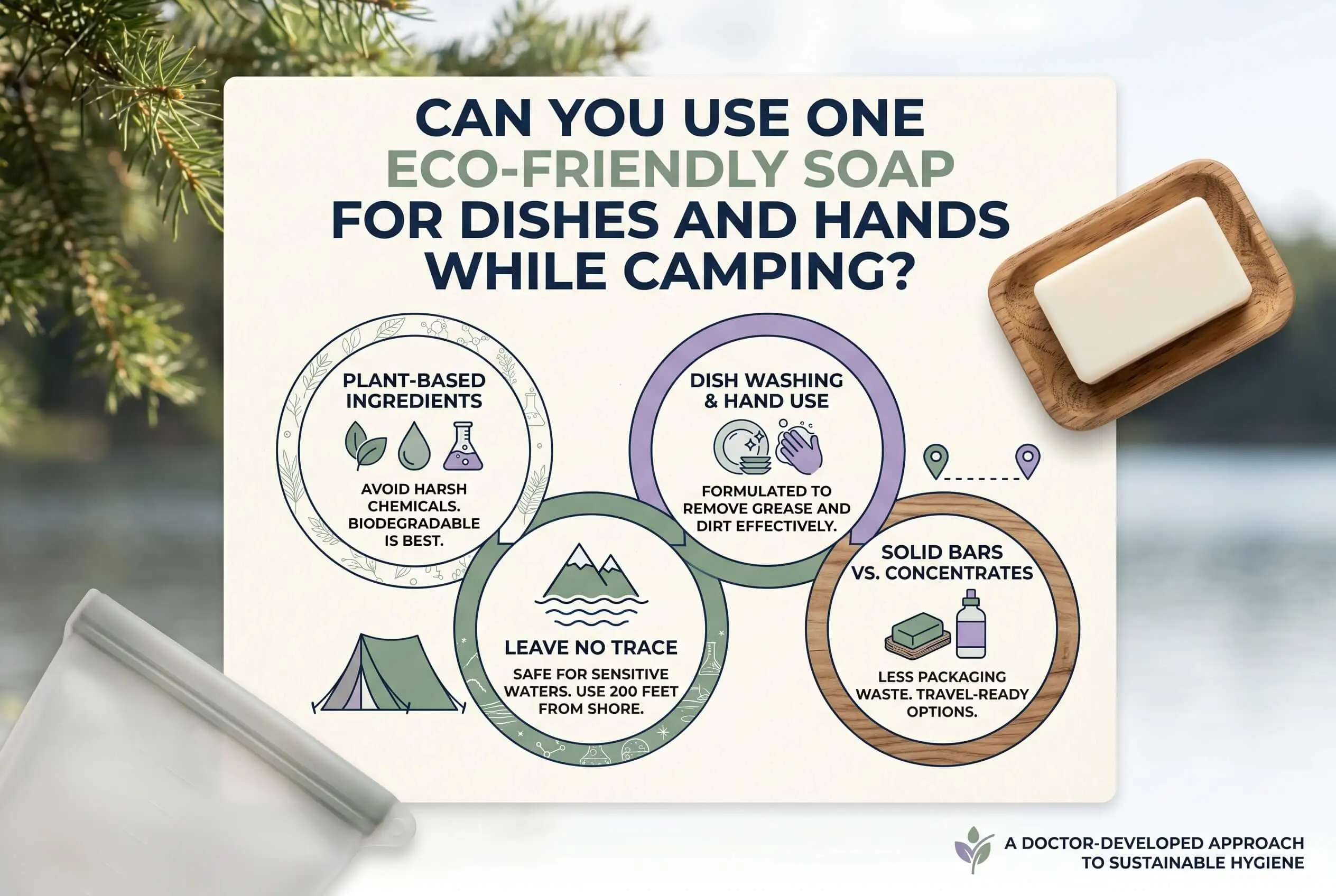
• Yes, if the soap is biodegradable, unscented, and concentrated.
• Use it at least 200 feet from any water source, every time.
• A few drops clean a full set of dishes. A pea-sized squirt is plenty for hands.
• Dispose of wash water by scattering on absorbent ground or pouring it into a cat hole six to eight inches deep.
• Look for plant-based surfactants, short ingredient lists, and certifications like EPA Safer Choice.
• Skip anything with high SLS, synthetic fragrance, triclosan, or phosphates.
• One small bottle or bar covers a weekend for two people.
Top Takeaways
• A biodegradable, unscented camp soap in concentrate form can cover both dishes and hands on a weekend trip.
• Carry your wash water at least 200 feet from every stream, lake, and wetland, every time.
• Dispose of soapy water in soil where bacteria can break it down, not in a stream.
• Scan labels for plant-based surfactants, EPA Safer Choice certification, and no added fragrance.
• A half-ounce of concentrate lasts two people a long weekend.
• Lift heavy grease off with a scraper before you soap a pan.
• Pack out food scraps, and scatter strained rinse water or bury it in a cat hole.
What "Eco-Friendly" Actually Means on a Soap Label
The word biodegradable shows up on more bottles than deserve it. A genuine biodegradable camp soap breaks down into harmless compounds when soil bacteria get hold of it, and that process works best in dirt rather than water. That’s why every federal land agency tells you to pour dishwater into a small hole instead of a creek. Plant-based surfactants, a short ingredient list written in plain language, and a certification like EPA Safer Choice or OMRI Listed are all good signs. An ingredient panel that reads like a chemistry quiz, or a product leaning heavily on “fragrance,” belongs at a kitchen sink.
For a quick refresher on how soap actually works at the molecular level, the Wikipedia entry covers the basics. Knowing why a genuine soap behaves differently from a synthetic detergent makes the backcountry rules from federal agencies click into place.
Why One Soap Can Handle Dishes and Hands
Hand soap and dish soap clean using the same mechanism. Both use surfactants to lift oils, grease, and microbes off a surface so water can rinse them away. Most of the difference between a drugstore hand soap and a drugstore dish soap comes down to fragrance, lather boosters, and sometimes antibacterial additives, all of which you want to skip for camping. A concentrated biodegradable soap strips that extra stuff out. What remains is a gentle cleanser that works on hands, a mess kit, your face, or a grimy bandana.
Where one-soap camping breaks down is hard, baked-on grease. Bacon fat on cast iron takes more scrubbing than Dawn at home, and no camp soap will feel like a miracle at that moment. I carry a small silicone scraper for that reason. Lift the food off first, and the soap only has to handle what’s left.
The Ingredient List to Scan Before You Buy
When I’m standing in an outfitter aisle, I run through a one-minute label check.
Things you want to see:
• Plant-derived surfactants (coconut or olive-based)
• A short, readable ingredient list
• Fragrance-free, or scented only with essential oils
• A biodegradable claim backed by a third-party certification
Things you want to skip:
• Sodium lauryl sulfate (SLS) in high concentrations
• Parabens and phthalates
• Synthetic fragrance or “parfum”
• Antibacterial agents like triclosan
• Phosphates
Fragrance matters more than most campers realize, which is why an unscented hypoallergenic hand soap is often the safer choice. A soap that smells like coconut or lavender broadcasts dinner to every bear and rodent within smelling distance, long before you’ve even started cooking.
How to Use Camp Soap Without Hurting the Water Source
This is the part most guides skim. A “biodegradable” label is not the same as a stream-safe label, even though most people read it that way.
Here’s the routine I use:
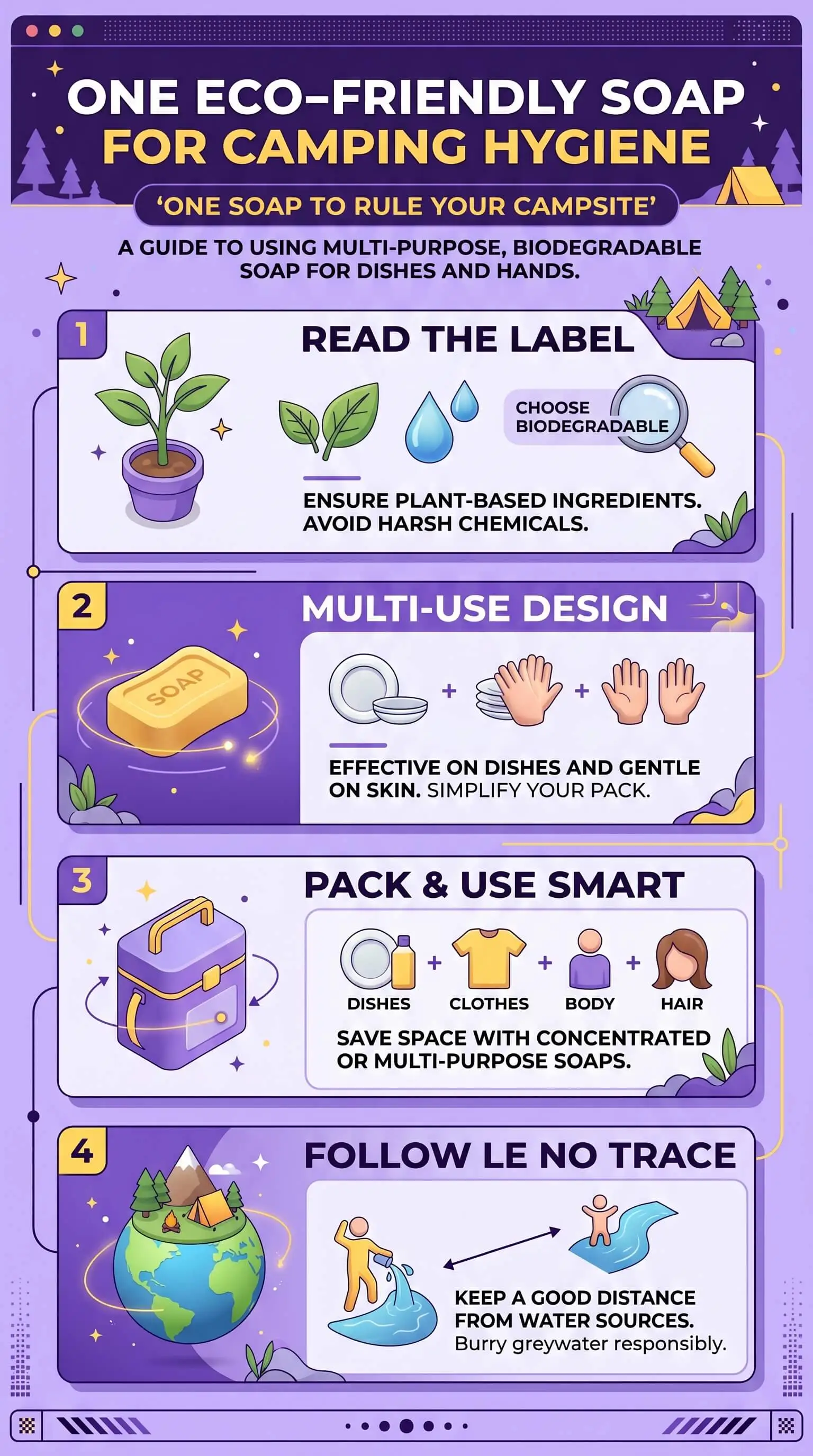
1. Fill a pot or small basin with water from the source.
2. Carry that water at least 200 feet away from any lake, stream, or wetland. Seventy big steps is a fair rule of thumb.
3. Use the smallest amount of soap that gets the job done: a drop or two for dishes, a pea-sized squirt for hands.
4. Scrub, rinse, and repeat if needed.
5. Strain out food scraps and pack those out with your trash.
6. Scatter the dirty water across absorbent ground in a wide arc, or pour it into a cat hole six to eight inches deep.
Every federal land agency repeats that 200-foot rule. Soil bacteria need time to break surfactants down, and running water doesn’t give them the chance.
Bar vs. Liquid Concentrate: Which Travels Better
I’ve packed both. Here’s how I choose now.
Bars:
• Light and cheap when dry, messy once wet
• Fine for one or two nights before they start slumping in the dish
Liquid concentrates:
• A half-ounce bottle lasts a weekend for two people
• Easy to dispense and dilute in any container
• Stays cleaner in the kit between trips
• Leak risk if the cap isn’t tight, so double-bag it
For most trips I reach for a small squeeze bottle of a concentrated castile-style soap. On ultralight weekends when I’m counting grams, a bar wrapped in a dry bag wins. Either format works, and the format matters less than the ingredient list.
“On a five-day trip through the Sierras two summers ago, I shared one two-ounce bottle of unscented castile concentrate with my partner for the full week. That bottle washed dishes after eight dinners, handled our hands after every meal and bathroom break, and still came home a third full. Every trip since then has taught me the same lesson: soap is the easiest thing to overpack, and one of the easiest things to take for granted out there.”
7 Essential Resources
A handful of sources have shaped how I think about camp soap over the years. Every one of these is worth a bookmark before your next trip.
7. Leave No Trace Center for Outdoor Ethics, “Skills Series: How to Do Your Dishes in the Backcountry.” Available at lnt.org/skills-series-how-to-do-your-dishes-in-the-backcountry. A step-by-step walkthrough of the one-bucket and four-bucket wash systems, plus the disposal rules every camper should have in memory.
8. Leave No Trace, “The Skinny on Soap.” Available at lnt.org/the-skinny-on-soap. A plain-spoken explainer on why “biodegradable” doesn’t mean “pour it in the lake,” with practical disposal guidance.
9. National Park Service, “Leave No Trace Seven Principles.” Available at nps.gov/articles/leave-no-trace-seven-principles.htm. The authoritative summary of backcountry ethics, with the 200-foot rule stated in its clearest form for every park visitor.
10. U.S. Forest Service, “Responsible Recreation.” Available at fs.usda.gov/visit/know-before-you-go/responsible-recreation. Federal land-management guidance covering soap use, waste disposal, and water protection across the national forests.
11. EPA Safer Choice Program. Available at epa.gov/saferchoice. The government-vetted certification program that screens cleaning-product ingredients for human and environmental safety.
12. REI Expert Advice, “Leave No Trace Principles.” Available at rei.com/learn/expert-advice/leave-no-trace.html. An approachable primer written for retail outdoor audiences, translating federal guidance into trip-ready language.
13. U.S. Fish & Wildlife Service, “Leave No Trace Principles.” Available at fws.gov/project/leave-no-trace-principles. Federal guidance for recreating on national wildlife refuges, with specific direction on soap and water separation.
3 Statistics
A few numbers worth carrying in your head the next time you’re packing for a trip or shopping for camp soap.
14. The Outdoor Foundation and Outdoor Industry Association’s 2025 participation report recorded 181.1 million Americans aged six and older participating in outdoor recreation in 2024, which represents 58.6% of the age-eligible population. Source: 2025 Outdoor Participation Trends Report.
15. Even biodegradable soaps can take between six months and several years to fully break down in water environments, according to the Leave No Trace Center for Outdoor Ethics. Source: Leave No Trace Skills Series.
16. The global biodegradable soap market was valued at roughly USD 74 million in 2024 and is projected to reach USD 109 million by 2032, a 5.6% compound annual growth rate. Source: Intel Market Research, Biodegradable Soap Market Report.
Final Thoughts and Opinion
A decade of packing for trips from the Pacific Northwest rain forest to high Utah desert has left me religious about two things: one bottle, and the 200-foot rule. Those two habits solve most of what the internet argues about. My kit is simpler, my pack is lighter, and the stream I hiked to is still clean when I leave it.
The brands on the shelf matter far less than what’s printed on the label and where you stand when you use it. Pick a good soap, use a small amount, keep it well away from water, the same care that supports sustainable agriculture and healthy soil. The rest is just miles on the trail.
Frequently Asked Questions
Is Dr. Bronner's Pure-Castile soap safe to use while camping?
Dr. Bronner’s Pure-Castile is one of the most widely used backcountry soaps, and it’s genuinely biodegradable. The label itself tells you to use it at least 200 feet from any water source and not to dispose of wash water directly in lakes or streams. Keep it away from water, use it sparingly, and it handles both hands and dishes well.
Can I wash dishes in a lake or stream if the soap is biodegradable?
No. Every federal land-management agency advises against it, and even biodegradable soap manufacturers say the same on their labels. Biodegradable soap needs soil bacteria and time to break down. Pouring it directly into moving water skips that process and pushes surfactants into an ecosystem that can’t filter them.
How far from water should I wash dishes and hands?
At least 200 feet, which works out to about seventy big steps. That distance gives soil a chance to filter any soap residue before it can reach a lake, stream, or wetland. The Leave No Trace Center established the 200-foot guideline, and the National Park Service, Forest Service, and U.S. Fish & Wildlife Service all repeat it in their backcountry guidance.
Does biodegradable soap work in cold water?
Yes, though cold water changes the feel. Soap lifts oils less aggressively in cold water, so you may need a second rinse or a longer scrub. Warming a small pot of water on a camp stove before washing dishes makes the job faster, especially after a meal that produced grease.
Bar or liquid camping soap: which travels better for backpacking?
It depends on trip length. A bar is lighter when dry and fine for a night or two. A concentrated liquid in a small squeeze bottle wins for trips of three or more days because it dispenses more precisely and dilutes easily. Both options work well. The choice comes down more to your style than to product performance.
How much soap do I actually need for a weekend trip?
For two people over a long weekend, a half-ounce of concentrated soap is usually plenty. Most campers use three to five times more than they need. The rule I follow: a single drop for a cup-sized dish, and a pea-sized amount for a full hand wash.
What makes a soap truly "biodegradable"?
A biodegradable soap breaks down into harmless compounds when soil microorganisms process it, the same microbial activity that supports healthy soil in subsistence farming. Key signals on the label include plant-derived surfactants, a short ingredient list, no synthetic fragrance, and a third-party certification such as EPA Safer Choice or OMRI Listed. No agency regulates the word “biodegradable” tightly enough for you to trust it alone.
Ready to Pack Smarter?
For your next trip, the Nowata Clean eco-friendly camping soap line is built around what this piece covers: unscented formulas, concentrated strength, and ingredients designed with the 200-foot rule in mind. Pick one bottle, use it carefully, and let the landscape you came to stay exactly the way you found it.