Based on how professional kitchens are run in real service environments, kitchen management covers far more than food execution. It includes inventory strategy, labor control, workflow design, food safety enforcement, equipment planning, and real-time decision-making under pressure. This article breaks down restaurant kitchen management from an operator’s perspective, focusing on the systems experienced kitchens rely on to protect consistency, control costs, and keep service from falling apart—day after day.
TL;DR Quick Answers
restaurant kitchen management
Restaurant kitchen management is the system that keeps a kitchen consistent, safe, and profitable. It includes workflow design, inventory and food cost control, staffing and training, food safety enforcement, and daily execution under pressure. Strong kitchen management replaces guesswork with repeatable processes so service holds up even on busy or understaffed nights.
Top Takeaways
Kitchen management is a system, not a job title
It keeps operations consistent, profitable, and compliant.Systems outperform talent under pressure
Clear workflows and standards beat heroics.Cost control and food safety protect margins
Inventory, waste, and sanitation matter daily.High turnover demands standardization
Processes must work regardless of staff changes.Predictability is the real win
Well-managed kitchens perform even on bad nights.
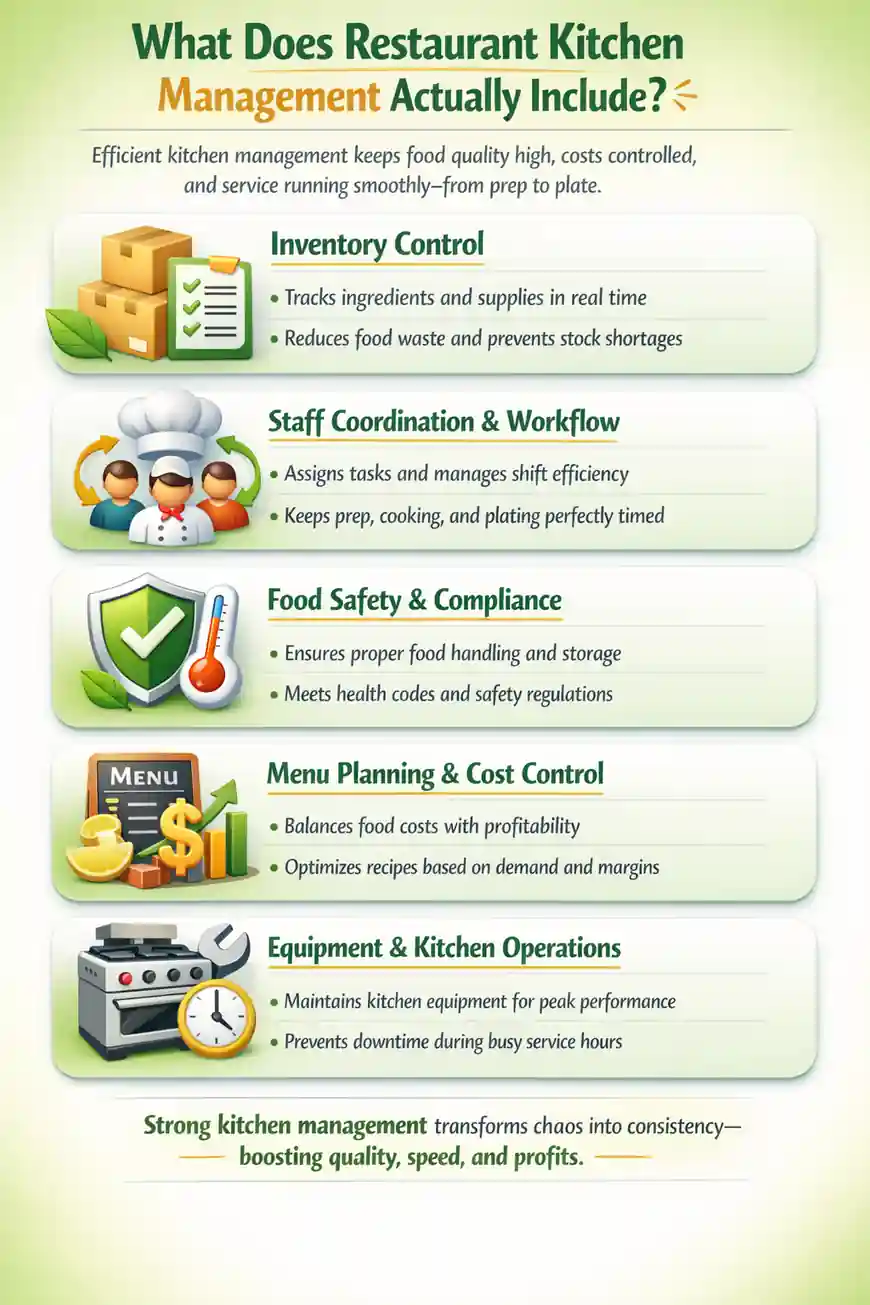
Restaurant kitchen management is the framework that turns a menu into a repeatable, profitable operation. It connects people, processes, and systems so food can be produced consistently, safely, and on time—regardless of volume, staffing challenges, or service pressure. At its core, kitchen management exists to reduce uncertainty: fewer mistakes, less waste, tighter costs, and smoother service.
Operational Workflow & Daily Execution
Effective kitchen management starts with how work moves through the kitchen. This includes prep planning, station setup, ticket flow, and communication during service. Well-managed kitchens design workflows that prevent bottlenecks, limit cross-traffic, and ensure every cook knows exactly what success looks like before the rush begins.
Inventory, Food Cost & Waste Control
Managing inventory is one of the most critical—and most overlooked—parts of kitchen management. This covers ordering, storage, portion control, yield tracking, and waste reduction. Strong kitchens manage ingredients proactively, not reactively, using par levels, rotation systems, real usage data, and a food recipe costing template to protect margins.
Staffing, Training & Labor Efficiency
Kitchen management also means building a team that can perform consistently. This includes scheduling, station training, cross-training, and setting clear performance standards. Well-managed kitchens balance labor cost with service demands so the kitchen runs efficiently without burning out staff or sacrificing quality.
Food Safety, Compliance & Quality Standards
Food safety is non-negotiable. Kitchen management enforces sanitation procedures, temperature controls, allergen handling, and health code compliance every day—not just during inspections. Quality control systems ensure dishes leave the kitchen the same way every time, regardless of who is on the line.
Equipment, Systems & Continuous Improvement
From equipment maintenance to kitchen layout and technology tools, management decisions directly impact speed and consistency. At the core of this is the kitchen brigade system, which defines clear roles, responsibilities, and reporting lines so every station runs smoothly. Strong kitchen leaders continually evaluate what’s slowing the team down, what’s costing too much, and where the kitchen brigade system can be adjusted to eliminate friction before problems affect guests.
In practice, restaurant kitchen management is about control, consistency, and accountability, all of which are reinforced by the kitchen brigade system. When this structure is properly implemented and supported by the right systems, the kitchen becomes predictable, scalable, and profitable, giving operators the stability they need to grow rather than constantly react.
“After years of working inside high-volume kitchens, one thing becomes clear fast: great kitchen management isn’t about reacting during service—it’s about the systems you put in place long before the first ticket prints. When inventory, prep, training, and food safety are managed intentionally, the kitchen stops relying on heroics and starts running predictably, even on the hardest nights.”
Essential Resources
If you’re serious about understanding how a professional kitchen is actually managed—not just how it’s supposed to work on paper—the resources below reflect the same practical, chef-driven, operations-first mindset used in working kitchens. These aren’t theory-heavy or corporate fluff. They focus on systems, accountability, and real-world execution.
National Restaurant Association — Industry Standards Every Kitchen Operates Under
Why it matters: Know the rules, benchmarks, and realities shaping professional kitchens
This resource outlines the operational standards, labor considerations, and compliance expectations that affect kitchens at every level, from independents to multi-unit operations.
https://restaurant.org/education-and-resources/
NetSuite — Inventory Control That Protects Food Cost
Why it matters: Stop losing money to poor ordering and waste
This guide explains how inventory systems, tracking, and forecasting directly impact food cost, spoilage, and purchasing decisions inside busy kitchens.
https://www.netsuite.com/portal/resource/articles/inventory-management/restaurant-inventory-management.shtml
WebstaurantStore — Hands-On Restaurant Operations Guides
Why it matters: Practical answers to everyday kitchen problems
A deep library of operational articles covering staffing, equipment, sanitation, and workflow—written for managers who need solutions they can use immediately.
https://www.webstaurantstore.com/food-service-resources/restaurant-management/
Toast — Kitchen Organization Tools That Reduce Service Chaos
Why it matters: Better systems mean fewer mistakes during the rush
Focuses on kitchen organization tools like par levels, prep planning, and station setup that help kitchens stay consistent when volume spikes.
https://pos.toasttab.com/blog/on-the-line/restaurant-kitchen-organization-tools
ServSafe — Food Safety Isn’t Optional
Why it matters: Compliance, safety, and risk management
ServSafe provides the food safety training and certification required for managers responsible for sanitation standards, temperature control, and health inspections.
https://www.servsafe.com/
Coursera — Structured Training for Kitchen Leaders
Why it matters: Build management skills beyond the line
Offers formal education on restaurant operations, leadership, and financial management for chefs and managers transitioning into larger leadership roles.
https://www.coursera.org/courses?query=restaurant+management
Together, these resources support a practical, operations-first approach to restaurant kitchen management that emphasizes accountability, efficiency, and long-term performance, while also helping kitchen leaders make smarter sourcing and inventory decisions aligned with sustаіnаblе agrісulturе to control costs, reduce waste, and maintain consistency at scale.
Supporting Statistics
Real kitchen management decisions are driven by measurable risk, not theory. The data below reflects what experienced operators already manage for every day.
Food safety failures are systemic, not accidental
CDC estimates 48 million foodborne illnesses annually in the U.S.
128,000 hospitalizations and 3,000 deaths each year.
This is why seasoned kitchens enforce daily sanitation checks, temperature logs, and training—every shift, not just before inspections.
Source: https://www.cdc.gov/food-safety/about/index.htmlFood waste directly erodes kitchen profitability
USDA reports 30–40% of the U.S. food supply is wasted.
In kitchens, this shows up through over-ordering, poor rotation, and weak portion control.
Strong inventory systems exist to protect margins, not add paperwork.
Source: https://www.usda.gov/about-food/food-safety/food-loss-and-wasteLabor instability is the operating reality
BLS shows a 4.8% quits rate in Accommodation and Food Services.
High turnover forces kitchens to manage for constant change.
Standardized training, station clarity, and repeatable workflows keep service consistent when staffing isn’t.
Source: https://www.bls.gov/news.release/jolts.t04.htmIndustry scale magnifies small mistakes
National Restaurant Association projects $1.5 trillion in sales.
15.9 million employees nationwide.
At this scale, inefficiency compounds fast—making systems, controls, and accountability essential.
Source: https://restaurant.org/research-and-media/media/press-releases/restaurant-industry-poised-for-growth-in-2025-industry-expected-to-employ-15-9-million-people-and-r/
Key takeaway:
Kitchen management exists to make operations predictable under pressure. The data confirms why experienced kitchens prioritize systems over improvisation.
Final Thought & Opinion
Restaurant kitchen management isn’t a title—it’s a discipline built under pressure.
Strong kitchens don’t rely on talent alone. They rely on systems that hold when things go wrong.
What effective kitchen management actually delivers:
Predictable service during high volume
Consistent food quality across shifts and staff
Controlled food and labor costs
Safer, more compliant operations
Less burnout and fewer emergencies
From firsthand experience, kitchens struggle when success depends on heroics. When processes live only in someone’s head, the operation becomes fragile and expensive.
The kitchens that last do three things well:
They design systems instead of relying on memory.
They train for consistency, not perfection.
They manage for bad nights, not ideal ones.
Final perspective:
Kitchen management isn’t about control for its own sake. It’s about protecting margins, people, and consistency so the business can grow instead of constantly recovering.
FAQ on Restaurant Kitchen Management
Q: What does restaurant kitchen management really cover?
A: It includes prep flow, station setup, inventory and food cost control, labor scheduling and training, food safety, sanitation, and maintaining consistency during busy service.
Q: How is kitchen management different from front-of-house management?
A: Kitchen management focuses on production systems, speed, accuracy, sanitation, and cost control, while front-of-house management centers on guest experience. Kitchen mistakes impact food quality, safety, and margins immediately.
Q: Why do food costs rise in poorly managed kitchens?
A: Food costs usually increase due to over-ordering, weak inventory tracking, inconsistent portions, poor rotation, and untracked waste. These issues compound quietly over time without strong management systems.
Q: Do small restaurants need formal kitchen management systems?
A: Yes. Smaller restaurants operate with tighter margins and leaner staffing, which makes clear systems essential for reducing chaos, protecting profitability, and preventing owner burnout.
Q: What separates effective kitchen managers from struggling ones?
A: Effective kitchen managers focus on building systems and standards that work under pressure, while struggling managers rely on memory and constant intervention to keep service moving.